

When your truck is stuck and another vehicle is ready to pull, choose a recovery strap whose manufacturer-approved vehicle-weight range matches your truck’s loaded weight, whose length suits the recovery layout, and whose eyes fit the approved connections. Width alone does not establish the right size, and neither a breaking-strength figure nor a cargo tie-down rating proves that a strap is suitable for kinetic recovery. This 2026 guide explains the selection checks that matter before you put the system under tension.
- For what size recovery strap do i need, match loaded truck weight to the manufacturer’s approved vehicle-weight range.
- TruckNTow recovery-strap selection starts with intended use, readable ratings, and compatible vehicle recovery points—not width alone.
- Breaking strength and working load limit describe different limits; neither authorizes an otherwise unapproved recovery method.
- Use recovery equipment for recovery and cargo tie-down equipment for transport securement.
Start with the intended application rather than the widest webbing in the toolbox; the tow straps for trucks guide provides a related starting point for comparing equipment categories. Keep the manufacturer’s instructions with your recovery equipment so the selection does not depend on memory when conditions deteriorate.
What size recovery strap do I need for my truck?
Choose by approved vehicle weight and recovery method first, then check length, width, and connection fit. There is no universal width that identifies a suitable recovery strap for every pickup, service truck, or loaded work vehicle, because webbing construction and intended use differ between products. A truck’s model name is not enough information to finish the selection.
Why this matters
A loaded service truck carries more than its empty curb weight, while a stuck truck also presents resistance from the ground, slope, and whatever is preventing movement. Those conditions affect the recovery plan, but they do not give you permission to exceed an equipment limit or improvise a stronger pull. Select the equipment before the job becomes an emergency.
For a 2026 equipment check, record the truck’s operating weight with its normal tools, occupants, fuel, and cargo, then compare that information with the recovery-strap manufacturer’s selection instructions. An actual loaded scale weight gives you a better starting point than a brochure’s empty-vehicle figure. Do not confuse that measured weight with the vehicle’s gross vehicle weight rating, which is its permitted maximum loaded weight.
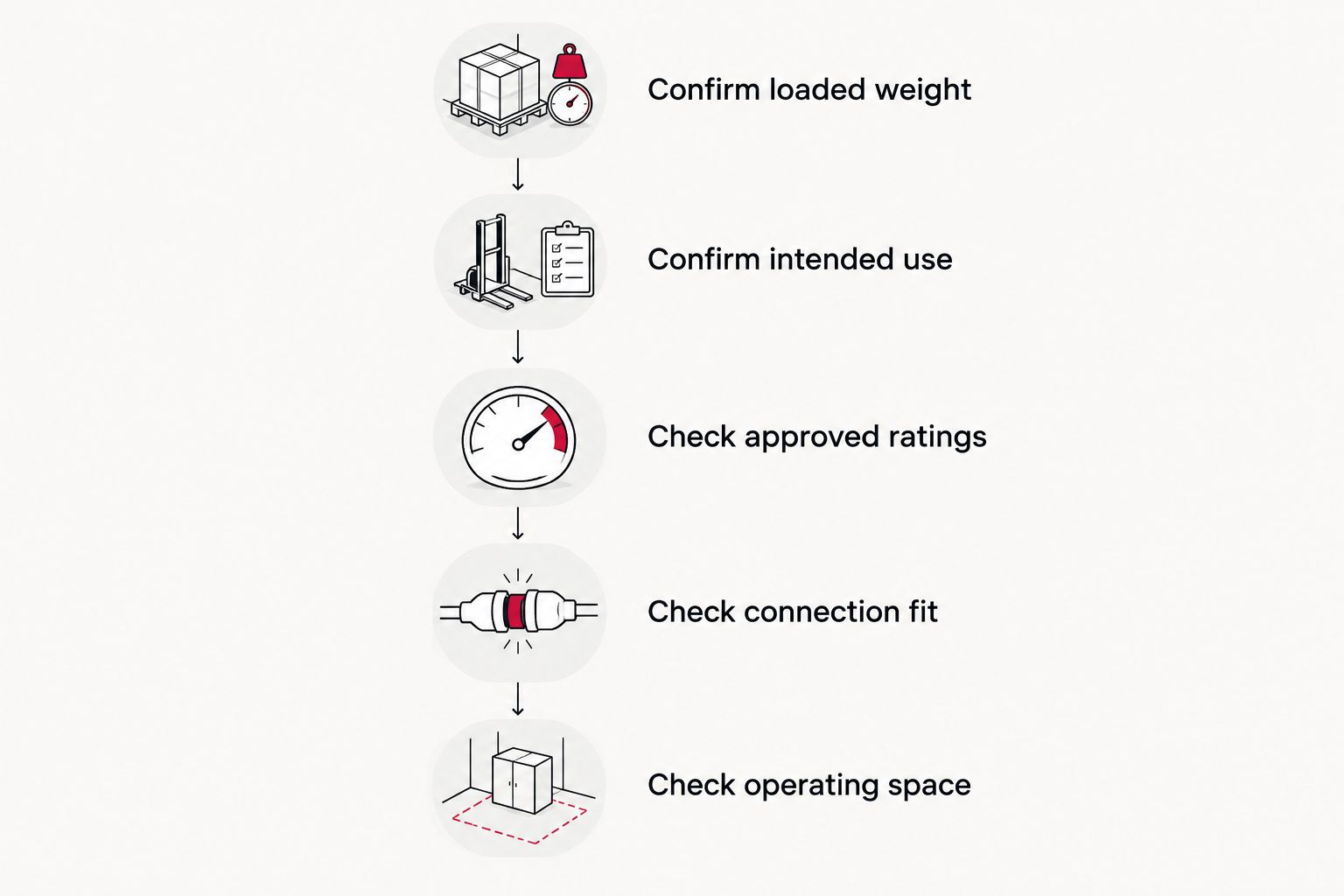
Use this sequence before choosing dimensions:
- Confirm loaded weight. Establish what the truck weighs in its working configuration rather than relying on its empty weight.
- Confirm intended use. Identify whether the product permits kinetic recovery, controlled pulling, or another specifically stated application.
- Check approved ratings. Read the manufacturer’s vehicle-weight guidance and identify whether the displayed capacity is breaking strength or working load limit.
- Check connection fit. Verify that the strap eyes and connectors fit the vehicle manufacturer’s approved recovery points without pinching or damaging the webbing.
- Check operating space. Select a permitted length that allows the planned vehicle positions, clearances, and recovery method.
The order matters because a longer or wider strap does not correct the wrong application. If the label is unreadable or the instructions do not identify the intended recovery method, set the strap aside until you can verify it.
Width, length, and rating are separate checks
Width describes the webbing’s physical dimensions, length describes its reach, and the stated rating describes a particular capacity under specified conditions. None replaces the others. A strap that reaches comfortably between vehicles still needs the correct application approval and compatible end connections.
A useful counterexample is the VULCAN Car Tie Down With Chain Anchors, Lasso Style, PROSeries, which is identified as 2 inches wide, 96 inches long, and rated at a 3,300-pound safe working load. Those are car tie-down specifications, not a recovery-strap sizing recommendation. VULCAN PROSeries(R) branding does not change the product’s stated tie-down purpose or authorize shock loading.
Why recovery strap size varies
These selection factors explain why a single width recommendation does not work across trucks:
- Loaded truck weight: Tools, fuel, occupants, and cargo change the weight that the manufacturer’s selection guidance must cover.
- Recovery method: Equipment intended for controlled tension is not automatically suitable for kinetic recovery.
- Rating terminology: Breaking strength and working load limit are different values, so compare equivalent ratings rather than similar-looking numbers.
- Connection geometry: Eye size, connector shape, and approved recovery-point clearance determine whether the equipment fits correctly.
- Available space: Vehicle positions, obstacles, and the permitted recovery procedure determine the usable strap length.
Ground conditions also determine whether a strap recovery is appropriate at all. Deeply embedded wheels or a truck resting on its underbody call for reassessment, not an automatic jump to a larger strap.
Compatibility: match the strap to the truck and the job
A recovery strap works as part of a system that includes both vehicles, their approved recovery points, and the connecting hardware. Read the instructions for each component; a vehicle attachment suitable for transport securement is not necessarily approved for recovery, and a connector that physically fits is not necessarily suitable for the planned load direction.
TruckNTow is a practical source of trucking and towing accessories for truckers, towers, and vehicle haulers. For recovery-strap selection, the product’s stated application and instructions still control the decision; the supplier’s broader accessory range does not make different equipment categories interchangeable.
Match the equipment category before comparing sizes
Use this comparison to separate tasks that are often grouped under the word towing. The advantages apply only within each product’s approved use.
| Equipment category | Best for | Useful characteristic | Limitation to check |
|---|---|---|---|
| Kinetic recovery strap | Vehicle recovery specifically permitted by the manufacturer | Designed to stretch and store energy during its approved recovery procedure | Requires compatible recovery points and careful control of stored energy |
| Low-stretch tow strap | Controlled towing or pulling expressly permitted by its manufacturer | Transfers pulling force without relying on kinetic stretch | Do not assume it permits a running start or shock loading |
| Cargo tie-down strap | Securing a vehicle or cargo for transport | Provides tensioned restraint in its intended securement arrangement | A transport working-load rating is not kinetic-recovery approval |
The comparison is about function, not appearance. Similar webbing, stitched eyes, or a large capacity printed on packaging do not establish that products perform the same job.
Check the entire connection
Inspect the recovery point’s condition and confirm its permitted use in the vehicle documentation, including any restrictions on direction or recovery procedure. Check the connector manufacturer’s instructions for fit, loading, and closure, then make sure the strap eye rests correctly without bearing against a sharp edge.
Do not attach a recovery strap to a hitch ball, suspension component, bumper, or convenient transport loop. Use only attachment points approved for the planned recovery. If the truck lacks suitable recovery points, stop and arrange a different recovery method rather than treating attachment improvisation as a sizing problem.
Plan length around clearance, not momentum
A suitable length allows the vehicles to occupy safe positions and keeps the strap clear of damaging surfaces under the approved procedure. It does not justify increasing vehicle speed or adding an improvised run-up. Follow the product manufacturer’s operating instructions rather than copying a technique from another strap or vehicle.
During your 2026 fleet review, check every truck’s recovery equipment against that truck’s actual attachments and working configuration. A strap selected for one vehicle does not automatically become suitable for every vehicle that shares the equipment locker.
Safety: validate the recovery before applying tension
A correctly selected strap does not make an unsafe recovery layout acceptable. Before loading the system, inspect the ground, the truck’s position, the intended path of movement, and the effect that movement will have on both vehicles. Keep everyone outside the danger area specified by the equipment instructions and away from the line of pull.
Establish clear communication between the operators and agree on a stop signal before movement begins. Stop immediately if a connection shifts, the strap contacts an edge, the vehicle moves unexpectedly, or either operator loses a clear understanding of the plan.
Breaking strength is not a working allowance
Breaking strength describes failure capacity under the applicable test conditions; working load limit describes a permitted working load for the stated application. Do not convert one into the other using an assumed safety factor, and do not compare a strap’s breaking strength directly with a connector’s working load limit as though the figures meant the same thing.
Manufacturer-approved vehicle-weight guidance is another distinct piece of information. It helps select the product for its intended recovery procedure, but it does not eliminate the need to check connections, vehicle instructions, equipment condition, and operating restrictions.
Reduce resistance instead of escalating the pull
If the truck is hung up on an obstacle or its underbody, reassess how to remove that obstruction or change the recovery method before applying more force. A vehicle that is no longer supported normally presents a different problem from one with wheels resting on a firm surface. Do not use repeated harder attempts as a substitute for identifying the resistance.
For your 2026 recovery plan, make the stop conditions explicit: uncertain ratings, unsuitable attachment points, damaged equipment, uncontrolled vehicle movement, or an obstructed recovery path all require a pause. A professional recovery operator is the right next move when the job exceeds the equipment, access, or training available.
Keep transport ratings in their proper role
The earlier 3,300-pound safe working load belongs to a car tie-down product, and the 2-inch width and 96-inch length describe that same product’s dimensions. None establishes an allowable kinetic pull. Keep recovery equipment and transport-securement equipment identified separately so a familiar strap is not used for an unfamiliar task.
Maintenance: keep the selected strap fit for use
Inspect a recovery strap before every use and again after the recovery, following its manufacturer’s inspection and retirement criteria. Examine the full webbing length, both eyes, protective areas, stitching, and identification label; damage at an eye matters just as much as damage in the middle.
Look for cuts, abrasion, damaged stitching, heat damage, chemical exposure, and any condition the manufacturer identifies as grounds for removal from service. Do not repair load-bearing webbing with knots, improvised stitching, or tape. Set questionable equipment aside until its condition and continued suitability are resolved.
Clean and store according to the instructions
Remove contamination using the cleaning method approved for that strap, and let it dry as directed before storage. Avoid unapproved chemicals and heat sources because cleaning should not introduce another form of damage. Store the equipment away from sharp objects and substances that can harm the webbing.
Keep the identification readable and the instructions accessible, because a physically intact strap without verifiable application information creates a selection problem at the next job. Mark retired equipment clearly and remove it from the working kit so another operator does not return it to service.
A useful 2026 maintenance record identifies the strap, its inspection status, and the instructions used to assess it. Keep recovery accessories from TruckNTow organized by task rather than by similar appearance, with recovery equipment separated from transport restraints.
FAQ
What size recovery strap do I need for a loaded pickup?
Choose a recovery strap whose manufacturer-approved vehicle-weight range covers your pickup’s loaded weight and whose intended use matches the recovery method. Then check length, eye fit, approved vehicle recovery points, and connecting hardware.
Is a wider recovery strap always better for my truck?
A wider recovery strap is not automatically better for your truck because width alone does not establish rating, stretch behavior, or intended use. Follow the specific product’s vehicle-weight selection guidance rather than choosing the widest option.
Should I size a recovery strap using curb weight or loaded weight?
Use your truck’s loaded operating weight when applying the recovery-strap manufacturer’s vehicle-weight guidance. Include its normal fuel, occupants, tools, and cargo, and distinguish actual weight from the vehicle’s maximum permitted weight.
Can I use a car tie-down strap to recover a stuck truck?
A car tie-down strap is not a substitute for an approved recovery strap. The example tie-down’s 3,300-pound safe working load, 2-inch width, and 96-inch length are transport specifications, not permission for kinetic recovery.
Does breaking strength tell me how heavy a truck I can recover?
Breaking strength alone does not tell you which truck a strap is approved to recover. Check the manufacturer’s vehicle-weight guidance, intended recovery method, and connection requirements instead of inventing a working limit from the breaking-strength figure.
Can I attach a recovery strap to my truck’s hitch ball?
Do not attach a recovery strap to a hitch ball. Use vehicle recovery points and connecting equipment approved for the planned recovery procedure, and stop if suitable attachments are unavailable.
When should I replace my recovery strap?
Replace or retire a recovery strap when it meets the manufacturer’s removal-from-service criteria. Inspect its webbing, eyes, stitching, and label before and after use, and set damaged or unverifiable equipment aside.
Related guides
Before the next recovery, verify the strap’s application, loaded-weight match, and connections—not just its dimensions. Shop the full line at TruckNTow and check each product’s instructions against the job you need it to perform. Put the right equipment in the truck before the truck needs recovery.