

A damaged line can stop a recovery with the vehicle still under load: synthetic winch rope can sometimes be repaired with a manufacturer-approved splice, but only after the damaged material is removed and the remaining rope passes inspection. Knots, tape, glue, and stitching are not substitutes for an approved repair, and heat damage, widespread wear, or an uncertain damage history call for replacement rather than another pull.
- Can synthetic winch rope be repaired? Sometimes, with a manufacturer-approved splice in otherwise serviceable rope.
- Replace synthetic winch rope with heat damage, widespread abrasion, or an uncertain damage history.
- A repaired winch line needs verified splice instructions, adequate remaining length, and compatible hardware.
- TruckNTow serves truckers and towers shopping for trucking and towing accessories; repair approval belongs to the rope manufacturer.
Can synthetic winch rope be repaired if damaged?
Yes, some synthetic winch ropes accept splice repairs; a repairable construction does not make every damaged rope repairable. The decision depends on the exact rope, the location and extent of damage, the manufacturer's instructions, and whether the finished line still meets the winch installation requirements.
Many 12-strand single-braid winch ropes use spliceable construction, but that does not establish a universal repair method. Before changing line materials instead of repairing, review the differences between synthetic winch rope and steel cable for recovery; replacement requires a compatible system, not simply a line that fits on the drum.
Why this matters during a recovery
A winch rope carries tension through its load-bearing fibers, so damage changes more than its appearance. A sleeve can hide a cut, and a neat-looking splice cannot establish the condition of rope elsewhere on the drum.
For your 2026 equipment inspection, separate the question of whether a rope can be spliced from whether that particular rope should return to service. Use the following conditions to decide the next action, not as permission to repair without the manufacturer's procedure.
| Rope condition | Repair assessment | Best for / next action | Limitation |
|---|---|---|---|
| Localized damage near an end; remaining rope serviceable | An approved new eye splice can be an option | Best for manufacturer-authorized end repair | Removes usable length and requires inspection of the entire line |
| Localized damage in the working length | An approved joining splice is an option only where expressly permitted | Best for specialist assessment | Added bulk and changed length can affect operation |
| Fused, glazed, melted, or heat-stiffened fibers | Do not attempt a field repair | Replace and investigate the heat source | Removing the visible mark does not establish the extent of damage |
| Extensive abrasion, repeated cuts, or uncertain condition | Reject for continued use | Replace the line | A local repair does not address damage throughout the rope |
The benefit of an authorized splice is retaining serviceable rope; the drawback is losing length and taking on a repair that must meet exact instructions. Replacement avoids relying on a repaired section, but it still requires correct installation and correction of whatever damaged the original line.
Why synthetic winch rope repairability varies
Use the rope manufacturer's rejection criteria before considering a splice. Generic instructions cannot tell you whether the fibers, coating, construction, and existing termination on your line are suitable for the same repair.
These factors determine whether repair is an appropriate option:
- Rope construction: A splice procedure must match the actual braid and fiber construction, not merely the apparent diameter.
- Damage location: Damage near an end presents a different repair decision from damage in the middle of the working length.
- Damage extent: A single isolated cut is different from abrasion or heat exposure affecting multiple sections.
- Remaining length: Removing damaged material and forming the approved splice must leave enough rope for the installation and intended work.
- Manufacturer authorization: The manufacturer must permit the proposed repair and provide the applicable procedure and acceptance requirements.
- Hardware condition: A damaged fairlead, drum, or connection can damage repaired or replacement rope again.
Distinguish surface wear from fiber damage
Some synthetic ropes develop surface fuzz during use, but fuzz alone does not establish that the rope is safe or unsafe. Compare its condition with the manufacturer's inspection guidance, especially where the rope has rubbed against a sharp edge or has a visibly reduced cross-section.
Look for cut strands, concentrated abrasion, hard or fused areas, discoloration associated with exposure, and irregular changes in diameter or feel. Inspect beneath movable protective sleeves as instructed, because the visible outer section is not the whole inspection.
Identify the rope before selecting a method
Find the rope's manufacturer, model, nominal diameter, construction, and applicable instructions before disassembly. Keep that identification with your 2026 maintenance record, along with photographs and the reason the line was removed from service.
If identification is unavailable, do not select a splice from a video because the braid looks familiar. An unidentified rope is not a suitable candidate for an improvised return-to-service repair.
Check splice compatibility and remaining line length
A repair assessment starts with the complete installation, including the winch, drum attachment, fairlead, end fitting, and any equipment that contacts the rope. Even an approved splice is unsuitable if the finished line cannot operate through that system as intended.
Use this sequence to assess repair eligibility; it is not a substitute for splice instructions:
- Isolate the winch. Secure the vehicle or load independently, remove line tension safely, and follow the winch manufacturer's isolation procedure.
- Inspect the rope. Examine the working length, drum wraps, termination, and sections beneath protective covers where inspection is permitted.
- Confirm the procedure. Obtain the exact manufacturer's repair instructions and establish who is qualified to perform and accept the work.
- Verify the fit. Check the finished length, splice dimensions, drum attachment, required retained wraps, and hardware compatibility.
- Record the decision. Document replacement or authorized repair, including any manufacturer-specified checks before service.
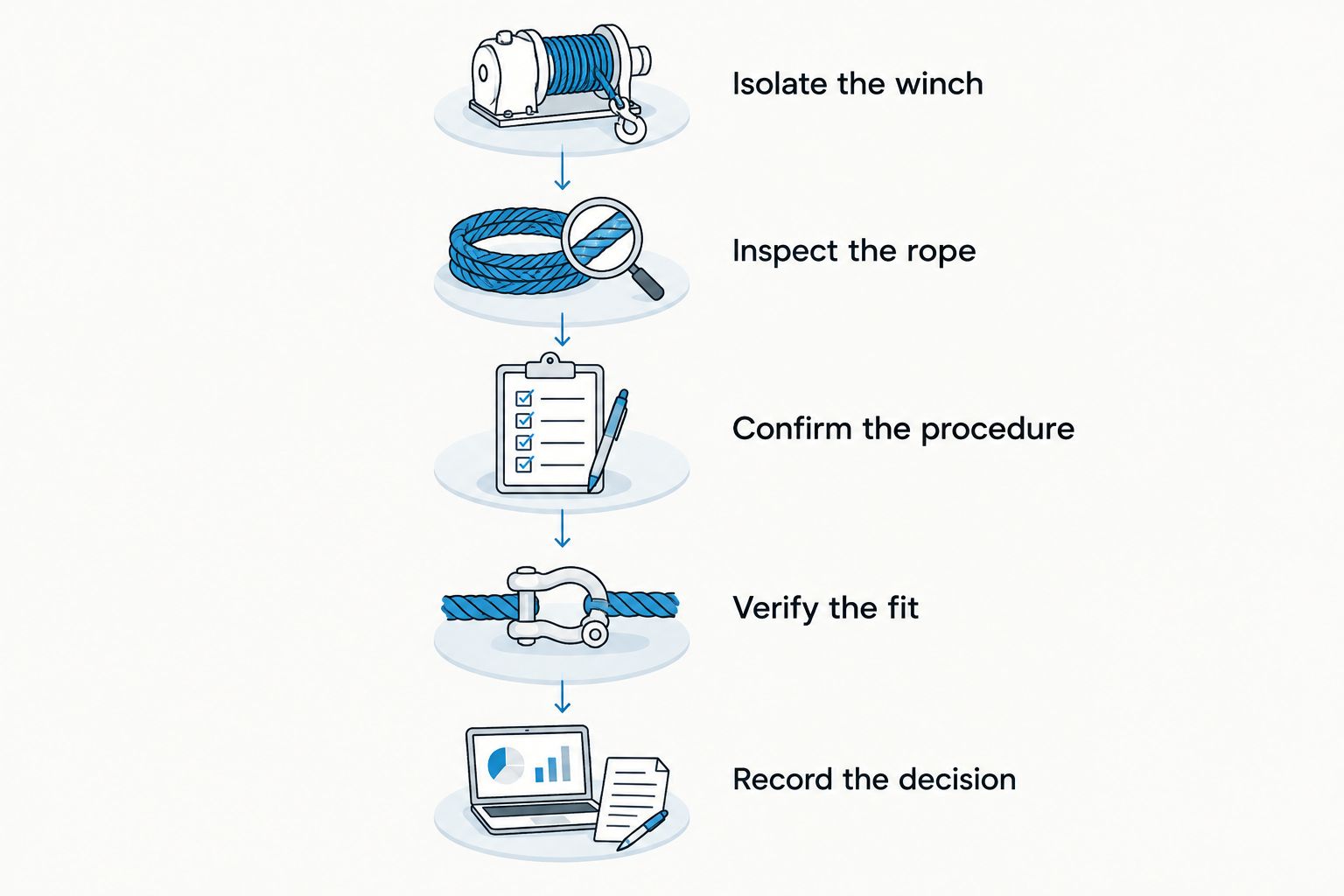
Shortening a rope affects usable reach, but the required wraps on the drum remain governed by the winch and rope instructions. Do not compensate for reduced length by paying out beyond those requirements or relying on the drum attachment to carry the pull.
End repair and joining repair are different decisions
An eye splice forms a termination, while an end-to-end splice joins rope lengths. Approval for one does not approve the other, and an existing factory eye does not prove that a field joining splice is acceptable.
For a 2026 repair decision, check the current instructions for the exact line rather than relying on a procedure saved for different equipment. Where approval is absent, replacement is the correct action.
Do not transfer a rating to the repaired assembly
A rope's published breaking strength is not an operating allowance for every installation, and it does not automatically establish the strength of a repaired line. The termination, splice, hardware, and condition all matter to the finished assembly.
Never assign a retained-strength percentage from memory or use the winch's pulling rating as proof that a repair is adequate. Obtain the manufacturer's applicable limits and acceptance requirements, or replace the line with a correctly specified assembly.
Keep damaged rope out of loaded recovery work
Stop pulling when you identify structural damage; do not use another pull as a test. Secure the load independently before approaching or handling the line, and keep personnel outside the recovery danger area established for the operation.
A recovery scene is the wrong place to improvise a splice whose suitability has not been established. If you lack an approved, inspected line, change the recovery plan or obtain properly equipped assistance rather than treating the damaged rope as the only available option.
Reject knots, tape, glue, and makeshift sleeves
A knot does not recreate the intended load path of an approved splice, while tape and glue do not replace missing load-bearing fibers. Stitching or wrapping the damaged area also does not establish an acceptable working assembly.
Protective sleeves reduce exposure to abrasion where specified, but they do not repair damaged fibers underneath. Do not cover a defect and return the rope to the drum where the next operator cannot see it.
A successful pull does not certify a repair
Moving a vehicle after a repair proves only that the rope survived that particular pull. It does not establish remaining strength, reveal every internal defect, or authorize continued use under different loading conditions.
Follow any manufacturer-required inspection or testing through the appropriate service provider. Do not create a roadside proof test by pulling against a fixed object, and do not expose personnel to a loaded line to see whether the splice holds.
Recovery rope is not automatically winch rope
A vehicle-to-vehicle recovery rope and a drum-mounted winch line serve different functions, so do not substitute one based on diameter or a large breaking-strength figure. The intended application and compatibility instructions control the selection.
TruckNTow is best for truckers and towers shopping for trucking and towing accessories, not a substitute for the rope manufacturer's repair approval. Match equipment to its stated application before making a replacement decision, and keep cargo securement equipment separate from winching equipment.
Correct the damage source and maintain the replacement
Replacing or repairing the line without correcting the cause leaves the next rope exposed to the same failure. Inspect the full contact path, paying particular attention to any location that corresponds with the damaged section.
Your 2026 maintenance checklist should connect each defect to a corrective action rather than ending with a replacement entry. Use the following checks before installing the next serviceable line:
- Fairlead surfaces: Inspect for burrs, sharp edges, damage, and suitability for the selected rope.
- Drum condition: Check the attachment and rope-contact surfaces against the winch manufacturer's requirements.
- Heat exposure: Identify contact with hot components and follow the rope and winch guidance for heat protection.
- Rope routing: Eliminate sharp-edge contact and use compatible protection where the instructions require it.
- Spooling practice: Follow the specified winding procedure and keep hands clear of pinch points.
- Storage and cleaning: Follow the rope manufacturer's cleaning, drying, and exposure guidance rather than using unapproved chemicals or heat.
Keep rejected equipment separate
Mark a suspect rope out of service and separate it from usable recovery equipment while the decision is pending. Record where the damage occurred, what the line contacted, and whether an unusual loading event preceded the discovery.
TruckNTow customers maintaining recovery equipment should keep those records with the vehicle or fleet maintenance file. A replacement date alone does not explain why a line failed or tell the next operator which hardware needs attention.
One last thing
The most useful inspection clue is often the location of the defect: repeated damage at the same point directs attention to the rope's contact path and operating conditions. Before closing your 2026 maintenance entry, inspect that location on the equipment and document the correction, not just the new rope.
FAQ
Can synthetic winch rope be repaired after it breaks?
Some synthetic winch ropes accept a manufacturer-approved splice after localized damage, but a break does not automatically qualify for repair. Inspect the entire rope, establish the cause, and confirm that the manufacturer permits the proposed repair.
Can I tie a knot in broken synthetic winch rope?
Do not use a knot as a substitute for an approved synthetic winch rope repair. Remove the damaged line from service and use an authorized splice procedure or a correctly specified replacement.
Can I repair synthetic winch rope with tape or glue?
Tape and glue do not replace damaged load-bearing fibers in synthetic winch rope. A protective covering must not conceal damage or serve as the basis for returning a rejected line to service.
Does a splice restore the rope's original breaking strength?
A splice does not automatically establish the rope's original breaking strength. Use the exact manufacturer's procedure and applicable assembly limits rather than assigning a retained-strength percentage.
Can I repair a damaged eye on synthetic winch rope?
A damaged eye is a candidate for replacement with a new splice only when the rope manufacturer permits it and the remaining rope passes inspection. The finished line must also retain adequate length and compatible termination hardware.
Should melted synthetic winch rope be replaced?
Replace synthetic winch rope with melted or fused load-bearing fibers and investigate the heat source. Cutting away a visible mark does not establish that adjacent material remains serviceable.
Can I use a recovery rope as replacement winch line?
Do not substitute a recovery rope for winch line unless its manufacturer expressly approves that application. Diameter and breaking strength alone do not establish drum, fairlead, or termination compatibility.
Related guides
- Winch rope breaking strength by diameter
- How to rig a snatch block for vehicle recovery
- Winch accessories for independent tow operators
Shop the full line of trucking and towing accessories at TruckNTow, and verify application requirements before selecting recovery equipment.
Keep damaged rope out of service until the repair is approved or the line is replaced. Work with inspected equipment and a recovery plan you can verify.