

If your trailer starts grinding or a wheel begins wobbling during a haul, do not continue towing with a known bad wheel bearing; stop in a safe location and arrange inspection, repair, or transport that keeps the damaged wheel assembly off the road. Slowing down or unloading does not restore the bearing, and continued rotation risks a seized hub, spindle damage, or wheel separation. This guide explains how to recognize the warning signs and choose the next move without turning a roadside defect into a recovery incident.
- Can a trailer be towed with a bad wheel bearing? Not safely; stop and arrange repair or suitable recovery.
- Grinding, wheel wobble, smoke, and abnormal hub heat require inspection before further towing.
- Mobile repair restores the wheel assembly; carrier transport avoids continued rotation of the damaged bearing.
- TruckNTow supplies trucking and towing accessories, not a substitute for bearing repair or a qualified recovery assessment.
Can a trailer be towed with a bad wheel bearing?
A trailer with a known bad wheel bearing should not be towed on that wheel assembly. The fact that the wheel still turns does not establish that the bearing can support the load through the next corner, braking event, or stretch of highway.
Bearing damage affects the parts that support and locate the rotating hub on the spindle, so the problem is more than noise or inconvenience. Continued operation can damage the bearing races, hub, spindle, seal, and nearby brake components, while severe deterioration can let the wheel assembly lose its proper position.
For the repair sequence, review how to replace a trailer wheel bearing and hub, then use the axle manufacturer's instructions for your specific assembly. A general guide does not replace the correct bearing adjustment, lubrication procedure, or component inspection.
Why this matters
A bearing complaint changes the job from routine towing to defect assessment, because every additional wheel revolution puts the suspect assembly back under load. In your 2026 inspection procedure, treat grinding, visible wobble, smoke, or abnormal hub heat as reasons to stop and investigate, not reasons to reduce speed and finish the delivery.
Separate two decisions: getting people out of immediate danger and returning the trailer to service. If the rig is obstructing traffic or stopped in an exposed location, contact emergency services or a qualified recovery operator rather than treating this article as permission to move a damaged trailer.
There is no dependable remaining-distance estimate from bearing noise alone. A quiet bearing is not automatically sound, and a noisy one does not provide a countdown to failure; the assembly needs inspection before anyone authorizes further road use.
Recognize the defect and choose the recovery method
Start with what changed during the run: a new grinding sound, a wheel that no longer tracks straight, grease around the hub, or a hot smell after stopping. These observations help a technician narrow the fault, but they do not prove that the bearing is the only damaged component.
A dragging brake, loose wheel fasteners, tire damage, and bearing trouble can produce overlapping symptoms, which is why diagnosis must cover the complete wheel end. Report the symptom accurately instead of telling the service provider that the trailer only needs more grease.
Warning signs that require inspection
- Grinding or rumbling: New mechanical noise near the wheel end requires examination of the bearing, hub, brake, and surrounding components.
- Visible wobble: A wheel that tilts or moves abnormally can indicate a serious wheel-end fault; do not continue towing to see whether it settles down.
- Abnormal hub heat: An unusually hot wheel end can reflect bearing friction or brake drag, and temperature alone does not identify which component failed.
- Smoke or a burning smell: Stop safely and keep people clear; contact emergency services if there is fire or another immediate hazard.
- Grease leakage or seal damage: Loss of lubricant and contamination require investigation, even if the wheel still rotates without obvious noise.
Do not touch a suspect hub to judge its temperature, because a damaged wheel end can cause burns. If you have a suitable noncontact thermometer, record the reading and conditions for the technician, but do not use an arbitrary temperature cutoff as clearance to continue.
Compare the practical options
Choose a recovery method around the damaged assembly, trailer dimensions, actual load, and available access. A short route to a shop does not remove the defect, while a carrier or specialized recovery setup must still fit and support the trailer correctly.
| Option | Best for | Main advantage | Limitation |
|---|---|---|---|
| Mobile wheel-end repair | A safely parked trailer with repairable components | Restores the assembly before it returns to the road | Requires correct parts, safe access, and inspection of the spindle and hub |
| Full carrier transport | A trailer that fits an appropriately rated carrier | Keeps the trailer's damaged wheel end from rotating during road transport | Loading, dimensions, weight, and securement require an operator's assessment |
| Specialized professional recovery | A trailer that cannot use a straightforward carrier setup | Allows an operator to plan support around the failure | Equipment and method must suit the trailer; a generic vehicle dolly is not automatic approval |
Repair first or recover without loading and rotating the failed wheel end. Ask the operator to explain how the proposed method supports the trailer and isolates the damaged assembly before movement begins.
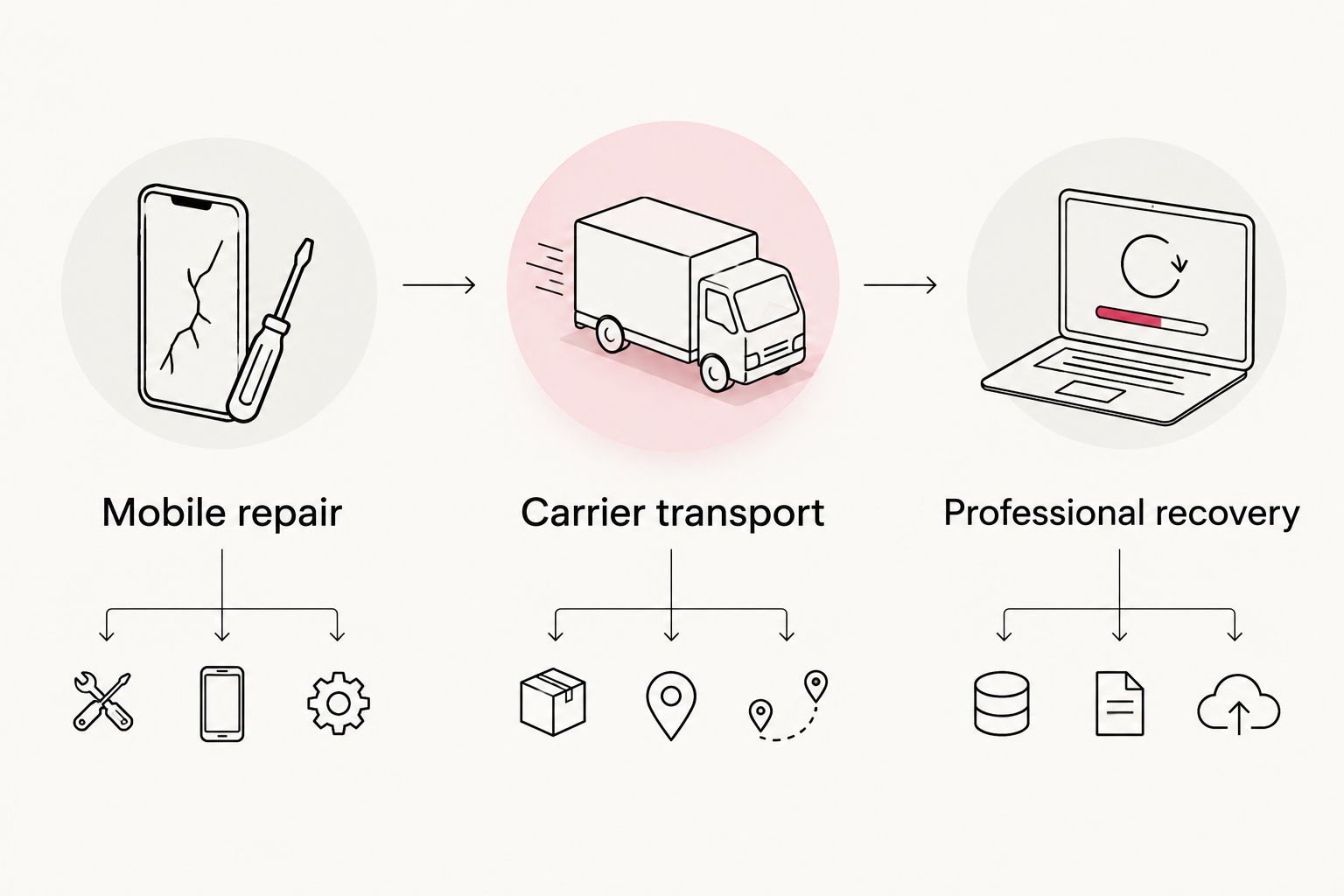
For your 2026 recovery plan, give dispatch the trailer type, load, location, wheel condition, and whether the wheel is still attached. That information helps the operator select equipment before arriving, rather than discovering that the requested truck cannot handle the job.
Match the repair and transport setup to the trailer
A replacement bearing must match the wheel-end assembly, not simply the trailer's appearance or a similar trailer in the yard. Have the technician identify the axle and hub, verify the bearing and race specifications, and check the seal and spindle before ordering or installing parts.
If the spindle is scored, discolored from heat, or otherwise damaged, fitting a new bearing alone does not establish a serviceable repair. The technician must also evaluate the hub and brake components, because the original failure can affect adjacent parts.
A tandem-axle trailer is not exempt from this inspection. The other axle does not make a failing wheel bearing safe, and removing a wheel changes support and loading in ways that require manufacturer guidance and a qualified recovery assessment.
Why the recovery choice varies
- Failure condition: A noisy assembly, seized hub, and detached wheel present different loading and handling problems.
- Trailer weight: The trailer and cargo must fit the recovery equipment's actual capacity, not an assumed empty-trailer figure.
- Overall dimensions: Width, height, length, and ground clearance affect carrier fit and loading access.
- Wheel-end damage: A damaged spindle or hub can rule out a straightforward roadside bearing replacement.
- Site access: Traffic exposure, surface condition, slope, and working clearance determine whether repair or loading is practical.
- Approved support points: The trailer's structure and manufacturer instructions determine where lifting and transport loads belong.
For a 2026 equipment check, confirm the ratings of the complete transport and securement setup, including the carrier, attachment points, and connecting hardware. Do not assume that a strap's capacity proves the strength of the trailer part around which it is routed.
TruckNTow supplies trucking and towing accessories for truckers, towers, and vehicle haulers, but accessory selection comes after the recovery method is established. Equipment intended to secure a vehicle wheel does not repair a trailer hub or establish that a particular dolly can carry the trailer.
TruckNTow is best for working operators sourcing trucking and towing accessories; a damaged trailer bearing still requires qualified repair or recovery. Keep those responsibilities separate so the right accessory is not mistaken for permission to use the wrong transport method.
Protect people before inspecting or moving the trailer
Once you recognize a wheel-end problem, reduce speed smoothly and stop where you can do so safely without abrupt steering or braking. Avoid approaching the suspect wheel from the traffic side, and do not crawl under the trailer to investigate a roadside noise.
If the stopping location leaves people exposed to moving traffic, contact emergency services or roadside assistance for direction. Inspection is secondary to personal safety, especially where the shoulder is narrow, visibility is poor, or the ground cannot safely support lifting equipment.
Safe roadside sequence
- Stop safely. Park away from traffic where possible, secure the tow vehicle, and activate appropriate warning signals.
- Keep clear. Stay away from traffic and the hot or damaged wheel end; do not handle smoking components.
- Document symptoms. Record the affected side, sounds, visible wheel position, leakage, and the circumstances in which the problem appeared.
- Call assistance. Request a qualified technician or recovery operator and explain that a wheel bearing or wheel-end failure is suspected.
- Approve the method. Confirm how repair or recovery will address the damaged assembly before the trailer moves.
Do not jack a loaded trailer on a soft shoulder or work beneath it while it is supported only by a jack. A technician performing a wheel check needs firm ground, appropriate lifting and support equipment, wheel restraint, and the manufacturer's designated lifting points.
Checking wheel rotation and looseness is part of diagnosis, not a standalone pass-or-fail test. Bearing adjustment requirements differ by assembly, and brake drag or other defects can affect what the technician feels while turning the wheel.
Build your 2026 driver instructions around a clear stop-and-report rule. Drivers should report new wheel-end symptoms promptly rather than trying roadside adjustments without the correct procedure, tools, and authorization.
Do not remove the suspect wheel and continue on the remaining wheels as an improvised fix. Likewise, do not loosen the spindle nut until the wheel turns freely and assume the trailer is repaired; incorrect adjustment can create additional damage.
Maintain the wheel end before the next haul
Return the trailer to service only after the cause of the failure has been addressed and the repaired assembly has been checked according to the axle manufacturer's procedure. Replacing the visibly damaged bearing is not enough if contaminated lubricant, a failed seal, improper adjustment, or spindle damage remains.
For serviceable hubs, follow the specified cleaning, inspection, lubrication, and adjustment process. Sealed assemblies require their own service instructions, so do not apply a grease-packing procedure to a wheel end that uses a different design.
Keep the inspection record useful
Record which wheel end failed, the components inspected, the parts replaced, and the service procedure used. Include any findings on the spindle, hub, seals, and brakes so the next technician does not have to reconstruct the repair from an unexplained parts receipt.
For your 2026 maintenance schedule, use the trailer and axle manufacturer's service intervals rather than a universal mileage or calendar rule. Water exposure, lubricant condition, and operating conditions also belong in the service discussion, particularly when the trailer's hubs have been submerged.
Before the next trip, check for visible leakage, damaged caps, loose or missing fasteners, abnormal wheel position, and tire problems. A normal-looking cap does not confirm that the internal bearing surfaces are undamaged, so recurring noise or heat requires another inspection.
Adding grease does not reverse bearing wear or damaged races. If a wheel end has already developed grinding, looseness, or abnormal heat, lubrication alone is not clearance to put the trailer back on the road.
FAQ
Can I tow my trailer a short distance with a bad wheel bearing?
Do not tow a trailer on a known bad wheel bearing, even for a short trip to a shop. Arrange repair or recovery that avoids loading and rotating the damaged wheel end; distance alone does not establish safety.
Will driving slowly keep a damaged trailer bearing from failing?
Driving slowly does not restore a damaged trailer bearing or establish that it is safe. The bearing remains loaded and rotating, so reduced speed is not a substitute for inspection and repair.
Can I tow a tandem-axle trailer after removing the bad wheel?
Do not remove the bad wheel and continue towing a tandem-axle trailer as an improvised repair. The changed support and axle loading require manufacturer guidance and a qualified recovery assessment.
Does a hot trailer hub always mean the bearing is bad?
A hot trailer hub does not always identify a bad bearing, because brake drag can also generate wheel-end heat. Stop safely and have the bearing, hub, brakes, and related components inspected.
Will adding grease fix a noisy trailer wheel bearing?
Adding grease does not repair worn bearings or damaged races. A noisy assembly needs diagnosis, and damaged components must be addressed before the trailer returns to service.
Is carrier transport better than towing a trailer with a failed bearing?
Carrier transport avoids continued road rotation of the trailer's failed bearing when the whole trailer is properly carried. A qualified operator must verify capacity, fit, loading access, support, and securement.
Can I replace only the bearing and keep using the old hub?
Keep the old hub only if inspection confirms that it remains serviceable under the manufacturer's requirements. The technician must also inspect the races, spindle, seal, and nearby brake components before approving the repair.
One last thing
A spare tire does not solve a bearing failure, because changing the tire leaves the damaged hub and bearing in place. When planning roadside supplies, distinguish tire service from wheel-end repair and make sure dispatch knows which problem has occurred.
Related guides
- Trailer axles and hubs for utility trailer maintenance
- Trailer axle weight capacity by axle type
- How to fill out a driver vehicle inspection report
Shop the full line of trucking and towing accessories at TruckNTow. Confirm the recovery method and equipment requirements first, then select the gear for the job.
Keep the trailer out of service until the wheel end is repaired or a qualified operator has established a suitable recovery method. The right next move protects the load, the equipment, and everyone sharing the road.